


 Written by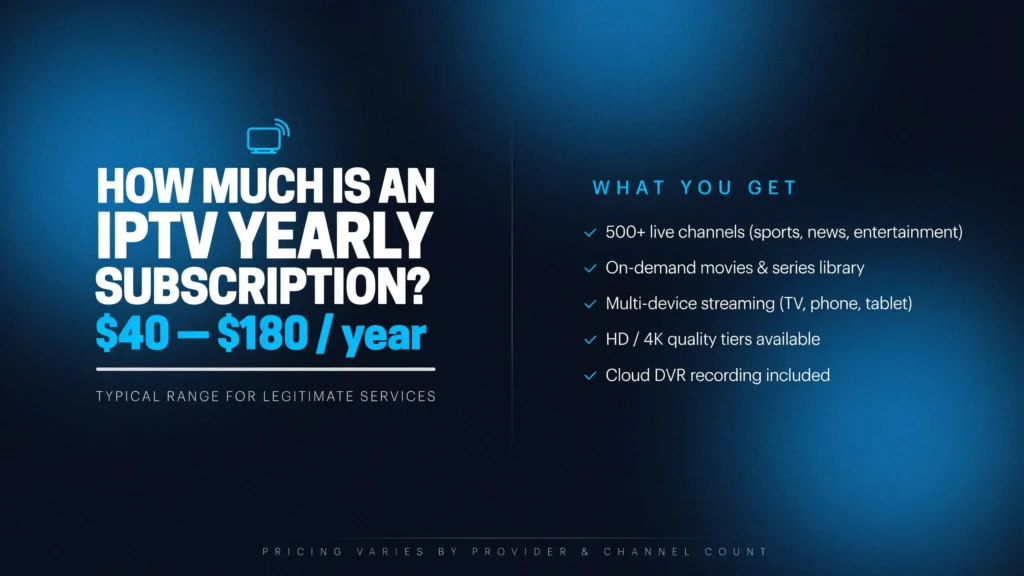
Understanding IPTV Yearly Subscription Costs: A Complete Guide
Streaming has changed the way we watch TV. Instead of being locked into cable or satellite contracts, more people now rely on IPTV (Internet Protocol Television) services to get their live channels, sports, movies, and international content. Yet one of the first things new users want to know is simple: How much is an IPTV yearly subscription? If you’ve searched forums, social media groups, or provider websites, you’ve probably seen wildly different numbers, which makes the decision even more confusing.
This guide walks you through the real-world pricing landscape so you can understand what’s a fair deal and what’s too good (or too risky) to be true. We’ll look at typical price ranges in different regions, why some services are dramatically cheaper than others, and how to factor in hidden costs like equipment and internet speed. By the end, you’ll be able to answer the question “How much is an IPTV yearly subscription?” for your own situation, instead of relying on vague promises or sales pages that leave out important details.
What Exactly Is IPTV?
Before diving into costs, it helps to be clear about what IPTV actually is. In simple terms, IPTV delivers television content over the internet instead of through traditional cable, satellite, or terrestrial signals. You can watch on a smart TV, streaming box, phone, tablet, or computer, as long as your device is connected to a stable internet connection. Many IPTV services offer live TV channels, catch-up TV, video-on-demand libraries, and sometimes even cloud DVR features.
However, not all IPTV services are created equal. On one side, you have fully licensed, legal IPTV platforms—often operated by telecom companies, large media brands, or well-known streaming services. On the other side, there are grey-market or outright illegal providers that resell streams without proper broadcasting rights. Both might call themselves “IPTV,” but their business models, reliability, and especially their pricing can be dramatically different. That’s a major reason it’s so hard to give a single universal answer to the cost question.
The Two Big Variables: Legal vs. Grey-Market IPTV
When people talk about IPTV pricing, they’re often mixing up numbers from legitimate services with prices from unlicensed resellers. Official IPTV services—think of the offerings your internet provider, mobile carrier, or regional TV network might bundle—usually sit within a fairly predictable price range. They pay for broadcasting rights, customer support teams, infrastructure, and taxes, so their fees tend to resemble traditional pay-TV, just delivered through newer technology.
Grey-market IPTV providers operate very differently. They might offer thousands of channels from dozens of countries, sports packages, and premium movie channels for a fraction of the price you’d expect. The catch is that they typically don’t have legal rights to rebroadcast that content. That can expose you to service shutdowns without warning, payment security issues, or even legal risks depending on your country’s laws. Knowing which category a service falls into is crucial when you’re comparing yearly subscription prices.
Typical Price Ranges Around the World
When people ask “How much is an IPTV yearly subscription?”, they’re often surprised by how wide the range can be. Some users report paying less than the cost of a single restaurant meal per month, while others are spending as much as a full cable package. The numbers you see online are influenced by where you live, what type of service you’re looking at (legal vs. unlicensed), and which channels or leagues matter most to you.
To give a broad, realistic picture, let’s separate official and grey-market services. For legal IPTV providers that operate within broadcasting regulations, a typical yearly subscription might run somewhere between the equivalent of USD $120 and $300, depending on your region and the size of the package. Grey-market IPTV services, by contrast, can advertise yearly prices from as low as $30 up to around $120. Those lower prices can be tempting, but they usually come with trade-offs in reliability, ethics, and safety that you should factor into your decision.
North America
In the United States and Canada, legal IPTV-like services are often packaged as “live TV streaming” bundles. Think of offerings that compete with cable and satellite by giving you major broadcast networks, news, sports, and entertainment channels over the internet. Monthly prices can range from about $40 to $80, which means you’re looking at roughly $480 to $960 per year before taxes and optional add-ons. Some telecom-operated IPTV platforms might come in a bit cheaper when bundled with internet, but they rarely match the ultra-low prices you see advertised by grey-market resellers.
On the unlicensed side, many North American users report paying around $60 to $120 per year for access to large IPTV channel lists via third-party apps or set-top boxes. These services often appear through word of mouth, messaging apps, or online forums, and they can disappear just as quickly as they appeared. Even if a yearly subscription seems cheap, you face the risk of losing your money if the provider shuts down, gets blocked, or simply stops responding once they have your payment.
Europe
Across Europe, IPTV pricing depends heavily on the strength of local competition and regulations. In countries with well-established telecom operators, you’ll often find IPTV bundled with fiber or DSL internet and landline services. Base packages might cost the equivalent of €20 to €40 per month, or around €240 to €480 a year. Sports and premium movie channels can add significantly to that total—especially if you want major football leagues, Formula 1, or exclusive movie premieres.
Grey-market IPTV is also widespread in Europe, with many providers targeting football fans who want access to matches that aren’t easily available or are very expensive on legal platforms. Advertised yearly prices often fall between €40 and €100. As always, the big question is whether the savings are worth the potential instability. A cheap 12-month subscription isn’t much of a bargain if crucial matches constantly freeze or disappear mid-season.
Middle East, Africa, and Asia
In the Middle East and parts of Asia, legal IPTV offerings often come from satellite broadcasters that are expanding into streaming, as well as regional telecom companies bundling TV with broadband. Prices can be relatively high compared with local incomes, especially for packages that include international channels or premium sports. It’s common to see yearly totals comparable to, or even higher than, Western prices once you factor in special add-ons.
Around Africa, Southeast Asia, and South Asia, informal IPTV resellers have filled gaps left by limited official options or high traditional pay-TV costs. Users in online communities often mention paying the equivalent of $30 to $80 per year. However, inconsistent infrastructure, variable internet speeds, and stricter crackdowns in some countries can make the actual viewing experience hit-or-miss. This reinforces why you shouldn’t judge value by headline price alone.
Breaking Down the Numbers: Monthly vs. Yearly
Another reason it’s hard to pin down a single answer is that many providers advertise monthly prices rather than yearly ones. To get a practical answer to “How much is an IPTV yearly subscription?”, you usually have to do a little math. That means multiplying the base monthly fee by twelve, then adding taxes, equipment rental (if any), and any optional extras like sports or premium movie packages. Only then do you see what you’ll really spend over a full year.
Imagine a legal IPTV provider that charges $20 per month for a standard package. On paper that looks straightforward: $240 per year. But if the provider adds a $10 monthly sports add-on during football season, a $5 equipment rental fee, and local taxes or broadcast fees, your actual yearly cost might end up closer to $320 or more. Many people only notice this once they check their bank statements several months into the subscription.
Now consider a grey-market IPTV reseller advertising a “one-time” yearly payment of $60 for thousands of channels. There usually aren’t extra taxes or official fees; what you see is what you pay. The trade-off is that you’re front-loading your risk. If the service collapses after three months, there is no refund, no customer support line to call, and often no way to legally recover your money. The lower yearly price comes bundled with a higher chance that you won’t actually receive twelve full months of smooth service.
What Affects the Cost of an IPTV Yearly Subscription?
Several factors shape the price you’re quoted for IPTV. The most obvious is the size and quality of the channel lineup. A minimalist package with local channels and a handful of international options will naturally cost less than a service that includes hundreds of HD and 4K channels from multiple regions, plus catch-up and on-demand libraries. If a provider includes major sports rights, first-run movies, or specialty international channels, the price usually reflects the licensing fees they have to pay.
Your location also plays a big role. Licensing deals are negotiated country by country, and some regions have stricter regulations or higher content costs. That’s why a similar-looking IPTV package can be noticeably more expensive in one country than another. Currency exchange rates, local taxes, and broadband infrastructure investments can all influence the final subscription price you see advertised.
Technical quality and simultaneous streams matter too. Services that offer reliable 4K streams, Dolby Atmos audio, and access on multiple devices at once need more server capacity and better infrastructure. That tends to push prices up, especially for fully legal providers with service-level commitments. A bare-bones service that only aims to be “good enough” for a single HD stream on one device can cut corners and reduce costs, but the viewing experience might not satisfy demanding users.
Sample Scenarios: Budget, Standard, and Premium Users
Because everyone watches TV differently, the real answer to “How much is an IPTV yearly subscription?” depends heavily on your habits and expectations. A single person who mostly watches news and occasional sports will land in a different price bracket than a family who streams content in multiple rooms every evening. Looking at a few realistic scenarios can help you map the general price ranges to your own lifestyle.
Budget-Conscious Viewer
Consider someone who mainly wants access to a few news channels, some entertainment, and maybe a handful of international stations from their home country. They might be able to use a smaller legal IPTV package bundled with broadband, or they might choose a basic grey-market service despite the risks. In practice, their yearly spending could range from $80 to $200, depending on whether they prioritize legality and reliability over minimum cost. For some, eliminating traditional cable and switching to a slim IPTV plan is already a big monthly saving.
Family Household
Now imagine a family of four. The parents want news and movies, one child loves cartoons, and the other follows sports religiously. They need multiple streams, a decent on-demand library, and solid reliability in the evenings. In many countries, that points toward a mid-tier legal IPTV package or a reputable live TV streaming service. Yearly costs here often fall between $250 and $600 once you include sports, HD or 4K quality, and any equipment or box rentals. The trade-off is that they’re paying for peace of mind: official support, predictable billing, and a lower chance of being cut off mid-season.
Sports Fan and Movie Enthusiast
Finally, picture a heavy user who watches live sports every weekend, follows multiple leagues, and also wants the latest movies and series. Their ideal setup might combine IPTV with separate streaming services for films and original shows. For this kind of viewer, sports rights drive costs more than almost anything else. On a legal IPTV platform, it’s easy for yearly spending to reach $400, $700, or even more, especially in markets where sports packages are sold as expensive premium add-ons. Some users look to illicit IPTV precisely to cut these costs, but that decision comes with its own set of risks.
Is a Yearly IPTV Subscription Actually Cheaper?
Many providers advertise a small discount if you pay annually instead of monthly, which leads people to wonder, “How much is an IPTV yearly subscription?” compared with paying month-to-month? On paper, the yearly option almost always looks cheaper; you might save the equivalent of one or two months of fees over a twelve-month period. For households that are certain they’ll keep the service for a full year, that discount can add up to meaningful savings.
However, committing to a yearly plan reduces your flexibility. If your financial situation changes, you move to a new home with a different internet provider, or you simply realize you’re not using the service as much as you expected, a prepaid yearly fee is much harder to recover. It’s even riskier with grey-market IPTV, because the provider can vanish or be shut down long before your year is up. When you assess whether an annual subscription is cheaper, you need to factor in those risks, not just the raw dollar amount.
A sensible approach for many people is to start with a monthly plan for a few months. This lets you test picture quality, channel stability, and customer support without locking yourself in. If you’re still satisfied after that trial period, upgrading to a yearly subscription can make sense—especially with reputable, legal providers that have a track record of consistent service.
Hidden Costs You Should Consider
When you focus solely on subscription pricing, it’s easy to forget the related costs that make IPTV actually work well. The first is hardware: you’ll need a compatible device such as a smart TV, streaming stick, dedicated IPTV box, game console, or even just a laptop. If your current TV is older, you might find yourself shopping for a new model or an additional streaming device, which can quickly add $30, $50, or far more to your overall investment.
Next is your internet connection. IPTV requires a stable, reasonably fast broadband line, especially if you want HD or 4K content and multiple simultaneous streams. Some households discover that their old internet plan struggles under the weight of several streams plus other online activity. Upgrading from a basic plan to a faster one can add an extra monthly cost, which effectively raises the real yearly price of your IPTV setup, even though that money goes to your internet provider rather than the IPTV service itself.
Some users also choose to pay for a VPN (Virtual Private Network) service for privacy, region-switching, or security reasons. While a VPN is not a magic shield that makes illegal streaming acceptable or risk-free, it can provide benefits such as encrypted traffic, protection on public Wi-Fi, and more control over how your data is routed. A reliable VPN typically costs between $40 and $100 per year, and that expense should be included when you calculate your true annual media budget.
How to Evaluate If a Yearly IPTV Subscription Is Worth It
Instead of fixating solely on the sticker price of an IPTV package, it helps to compare it to what you’re currently paying—and how much value you’re getting in return. Start by listing your existing TV and streaming expenses: cable or satellite bills, premium channels, standalone streaming services, and perhaps even pay-per-view sports. Add those numbers together for a full year, then compare them to the combined cost of IPTV, internet upgrades (if needed), and any extra apps you’d want to keep.
Also consider the non-monetary factors. Will IPTV give you channels or content you can’t easily get through other means, such as foreign-language stations, niche sports, or regional news? Does it simplify your setup by consolidating multiple services into one interface, or does it make things more complex with additional apps and logins? A yearly subscription might be cheap on paper but still not worth it if you rarely watch the content it provides.
One good way to approach the question “How much is an IPTV yearly subscription?” is to reframe it slightly: “How much value do I get from an IPTV yearly subscription at that price?” If the answer is “a lot”—because it replaces several older services, fits your habits, and runs reliably—then even a higher annual figure might be reasonable. If the answer is “not much,” then the cheapest option may still be too expensive for what you actually use.
Red Flags and Safety Tips When Choosing IPTV
Price should never be your only decision point. With IPTV, extremely low prices can sometimes signal serious problems. Be wary of providers that refuse to give clear contact information, push only untraceable payment methods, or promise every channel under the sun for a rock-bottom fee. In the worst cases, these operations are little more than short-lived cash grabs that disappear as soon as they’ve collected enough money from subscribers.
When you see offers that make you wonder “How much is an IPTV yearly subscription?” and the answer seems to be “almost nothing,” take a step back. Ask yourself how a provider could possibly pay for servers, bandwidth, and content rights at that level. If the numbers don’t add up, there’s a good chance the service is cutting corners that could hurt you—through poor performance, exposure of your payment details, or legal issues if authorities decide to crack down on illegal streaming in your region.
To protect yourself, look for a clear refund policy, documented terms of service, and independent reviews from long-time users, not just sponsored posts or affiliate links. Official IPTV services tend to be more transparent because they operate under regulation and have reputations to protect. While no provider is perfect, companies that invest in customer support, security, and long-term stability are more likely to deliver the service you paid for over an entire year.
Frequently Asked Questions About IPTV Pricing
Why do IPTV prices vary so much from one provider to another?
IPTV prices reflect a mix of content licensing costs, infrastructure expenses, competition, and business models. Legal providers that pay for official broadcasting rights, maintain support teams, and operate large server networks naturally charge more. Grey-market providers skip many of these costs, which lets them advertise much lower prices—but also introduces serious risks. Additionally, some services invest heavily in features like advanced apps, cloud DVR, and multi-device support, all of which push costs higher.
Are there any truly free IPTV options?
There are some free, legal IPTV-like offerings, usually focused on limited channel lineups or ad-supported content. For example, certain news channels, public broadcasters, and niche networks may stream live feeds online at no cost. There are also official “FAST” (Free Ad-Supported Television) platforms that bundle many channels together and earn money through advertising instead of subscription fees. However, free options rarely replace a full pay-TV package; they’re best thought of as supplements rather than complete solutions.
How much is an IPTV yearly subscription? A realistic range for a family of four who watches TV most evenings
For a typical family household that wants a mix of news, entertainment, kids’ channels, and sports, a realistic yearly budget for legal IPTV or live TV streaming often falls between $300 and $700, depending on your country and the specific sports or premium channels you choose. You might pay less if you skip sports or accept fewer channels, and more if you add multiple premium packages. Grey-market IPTV can reduce that headline number dramatically, sometimes to under $120 per year, but you need to weigh those savings against the higher risk of outages and potential legal concerns.
Can I negotiate or reduce the cost of a legal IPTV subscription?
In some cases, yes. If your IPTV service is bundled with internet or mobile service, you might be able to get a better price by calling your provider and asking about promotions, loyalty discounts, or bundle deals. Switching to a smaller channel package, dropping rarely watched premium add-ons, or paying yearly instead of monthly can also lower your total costs. Just be sure to read the fine print: some “discounts” lock you into contracts with early termination fees if you decide to cancel before the term is up.
Does an IPTV subscription include Netflix, Disney+, or other streaming apps?
Usually not. IPTV focuses on live TV channels and sometimes on-demand libraries controlled by the provider. Major subscription streaming services such as Netflix, Disney+, Amazon Prime Video, and others operate independently and require their own separate subscriptions. Some IPTV set-top boxes or smart TV interfaces might integrate these apps in one place, but you still need to pay for them individually. When you calculate your yearly media costs, remember to include any standalone streaming services you plan to keep alongside IPTV.
Conclusion: What You Can Expect to Pay
IPTV has opened up more choice than ever in how we watch television, but it has also introduced a wide range of pricing structures that can be confusing at first glance. Legal services that operate within broadcasting laws tend to sit somewhere between roughly $120 and $300 per year for basic to mid-tier packages, with higher prices for extensive sports and premium content. Grey-market services can undercut those figures substantially, but they do so by accepting trade-offs that many viewers only recognize when something goes wrong.
If you still find yourself asking “How much is an IPTV yearly subscription?”, the most honest answer is that it depends on what you watch, how much risk you’re willing to tolerate, and how important reliability is to you. Instead of chasing the absolute lowest price, focus on matching a service’s strengths to your viewing habits, then compare its yearly cost to what you’re paying today. That way, whichever IPTV subscription you choose, you’ll know you made the decision with clear eyes and realistic expectations.
